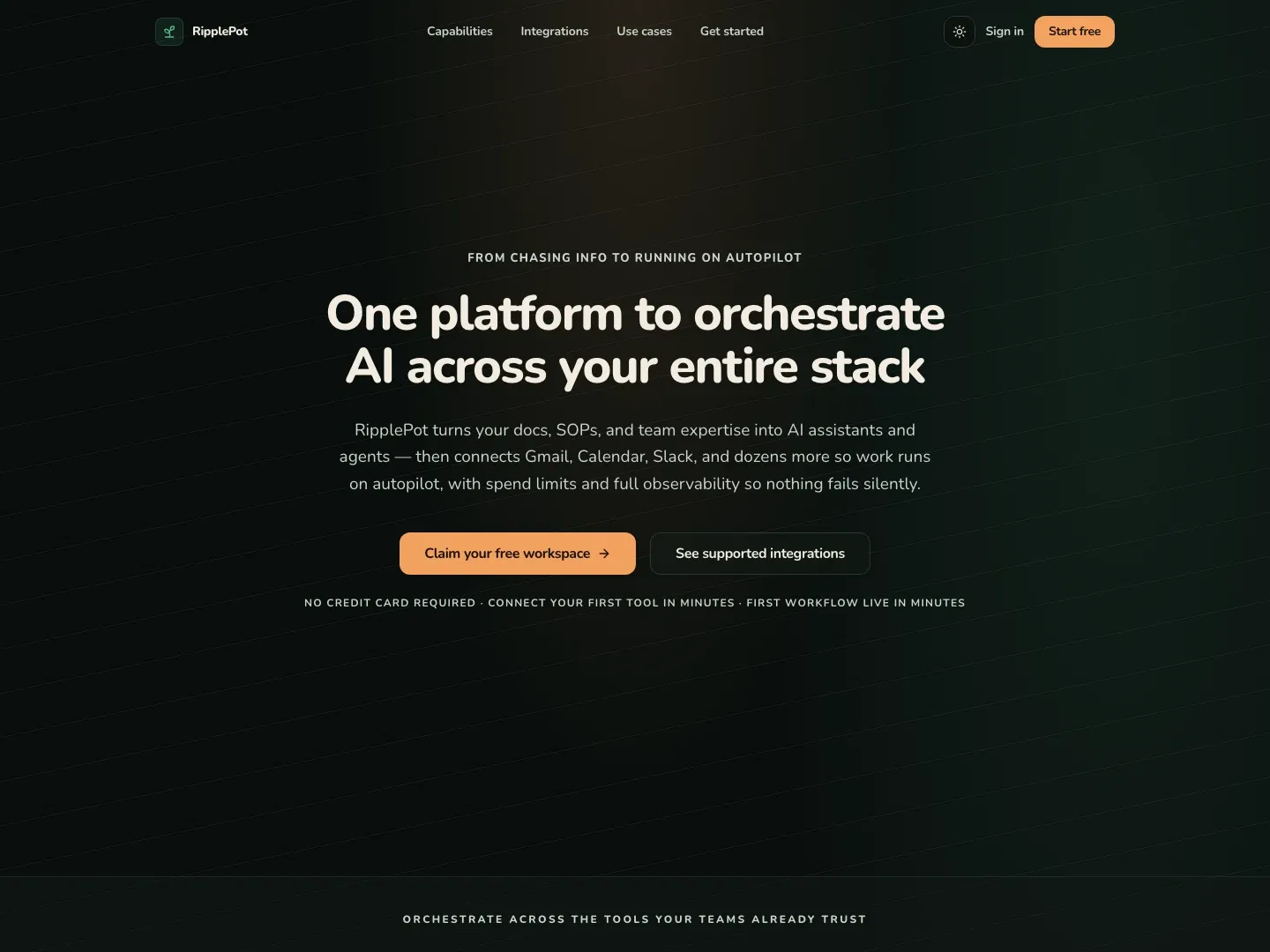
RipplePot
A workflow automation platform built around AI agents
A multi-tenant product for building automations on a visual canvas, where AI agents, app integrations and human approvals are steps in the same flow.
The challenge
Most automation tools were designed before language models were useful. They connect apps well, but an AI step is bolted on as one more box. Real processes need more than that: an agent that can use tools, a person who signs off before money moves, a pause until something happens, and a clear record of what the automation did and what it cost.
We set out to build a platform where those are first-class parts of a workflow. The result is RipplePot.
The requirement
- A visual editor for building workflows from nodes.
- AI agents that can call tools and hand off to each other, with a choice of model provider.
- Triggers from schedules, webhooks, app events and chat.
- Human approval as a step that pauses a run and resumes it.
- Answers grounded in a team’s own documents.
- Usage metering, so every run has a measurable cost.
- Organisations, workspaces and roles, so many teams can use one deployment.
The solution
Workflows are built on a canvas from a deliberately small set of nodes: conditions, loops, variables, waits, AI agents, single app actions and human approvals.
Agents run on the OpenAI Agents SDK and can use toolkits, return structured output, keep memory and hand off to other agents. Teams can bring their own keys for other model providers. Knowledge bases let an agent answer from uploaded files.
A run can wait for a delay, a date, an external event or an approval. Approvers act from an inbox or from a secure link, and the run continues from where it stopped.
Workflows start manually, on a schedule, from a signed inbound webhook, from an event in a connected app, or when another workflow finishes. They can also be exposed as a chat widget or a form embedded on a website.
Every run records token usage against a model price catalogue and a credit ledger, with limits and usage alerts per organisation.
Architecture
The backend is a modular NestJS application on PostgreSQL.
The run queue is the database itself. Runs are claimed with row-level locking so two workers never take the same one, and workers are woken by database notifications. Live run traces and chat messages reach the browser over server-sent events through the same mechanism. That gives reliable queuing without a separate queue service to operate, and the queue interface is written so one can be added later.
The engine walks a workflow graph one node at a time through a registry of executors, each with a timeout, under a cap on total steps. When a run pauses for a wait or an approval, its state is saved, and a dispatcher resumes it. A sweeper recovers runs that were interrupted.
Credentials for connected apps are encrypted at rest, inbound webhooks are signature-verified, and actions are written to an audit log.
Technology
NestJS, TypeScript, PostgreSQL, TypeORM, Next.js, React, React Flow, TanStack Query, the OpenAI Agents SDK, Composio for app integrations, and server-sent events.
Outcome
RipplePot is a 7Webs product, deployed and open for sign-up. The workflow engine, editor, agents, triggers, approvals, knowledge bases, embeddable widgets and metering are built. It is also where we work out the patterns we use in client automation projects: bounded agents, human sign-off, and a measured cost for every run.